
Navigating Complexity: Challenges and Solutions in Implementing §14a EnWG for Energy Suppliers
Hydrogen Derivatives
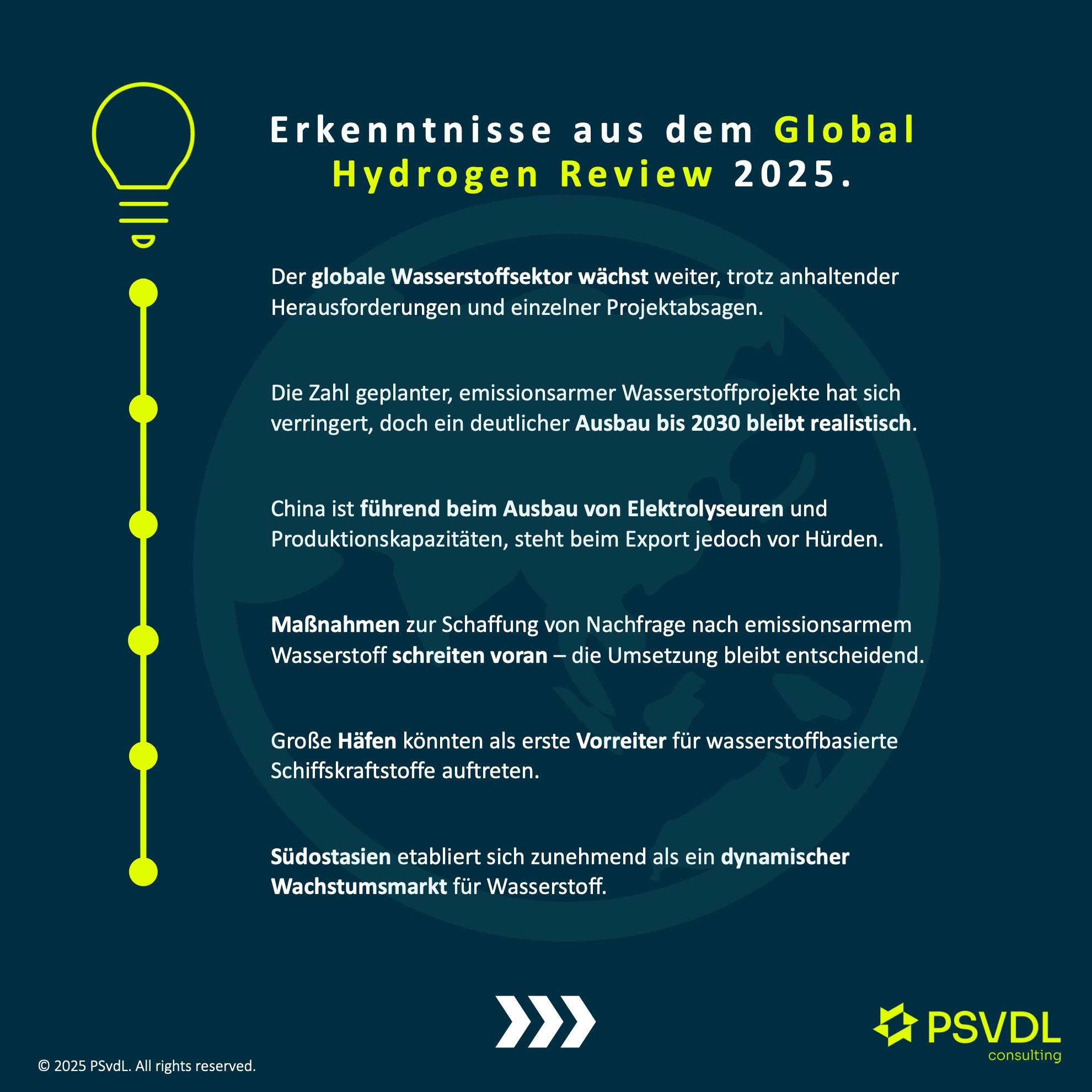
1. The hydrogen sector continues to grow fundamentally despite hurdles
Global H2 demand rose by approx. 2% in 2024. However, high costs, uncertain demand, regulations, and slow infrastructure expansion hampered further potential.
2. The project pipeline for low-emission H2 has shrunk for the first time, yet strong expansion is expected by 2030
The projected production of low-emission H2 based on announced projects until 2030 is declining for the first time, particularly for electrolysis and CCUS projects in Africa, the Americas, Europe, and Australia. At the same time, the number of projects with a final investment decision increased by almost 20% compared to 2024.
3. China leads in electrolysers and production capacity, but faces international obstacles
China dominates the installation and manufacture of electrolysers worldwide. With an output of 3 GW, the country holds approx. 65% of global electrolysis capacity. Outside the country, Chinese electrolysers are currently not significantly cheaper, but manufacturers are working on innovations and exploring production expansion abroad.
4. Policy measures to promote demand are progressing, but implementation remains crucial
In 2024, the growth in new H2 off-take agreements was lower than in the previous year, particularly in the refinery, chemical, and shipping sectors. As a measure, Europe, for example, is implementing sectoral hydrogen quotas in transport and industry, the national implementation of which is still pending and will only then provide clear demand signals.
5. Southeast Asia is establishing itself as a significant market for H2